

A nature inspired stitch design is the deliberate use of natural motifs and thread techniques to create textile art that reflects elements like flowers, leaves, birds, and landscapes. In embroidery and cross stitch, this approach is formally called nature themed embroidery or botanical stitch work. It draws from the organic world and translates it into thread, color, and pattern. Whether you stitch a single wildflower or a full woodland scene, the same core principles apply: choose your motif, pick your palette, and select the stitches that best capture the texture and feel of nature. This guide walks you through everything you need to know to get started with confidence and joy.
What are the common motifs and color palettes in nature inspired stitch designs?
Nature inspired stitch designs use flora, fauna, landscapes, and cellular shapes as their core visual vocabulary. Each motif carries its own mood and works differently depending on your project size and skill level.
Popular motifs include:
- Flora: Roses, daisies, ferns, oak leaves, cherry blossoms, and trailing vines
- Fauna: Songbirds, butterflies, dragonflies, bees, and foxes
- Landscapes: Rolling hills, forest canopies, coastal cliffs, and river bends
- Cellular geometries: Honeycomb structures, seed pods, and snowflake formations
Motif selection shapes the entire mood of your piece. A delicate sprig of lavender feels calm and soft. A bold eagle in flight feels powerful and graphic. Your motif choice guides every other decision you make.
Color palette matters just as much as the motif itself. Nature themed embroidery typically draws from four main color families:
- Greens and earth tones: Sage, moss, ochre, terracotta, and warm brown
- Blues and grays: Sky blue, slate, dusty teal, and soft navy
- Warm florals: Blush, coral, golden yellow, and deep burgundy
- Seasonal shifts: Crisp white and silver for winter, burnt orange and rust for autumn
The best palettes feel cohesive because nature itself is cohesive. Leaves and stems share undertones. Petals echo the sky. When you pull colors from a single season or ecosystem, your finished piece holds together naturally.
Pro Tip: Pick your thread colors outdoors in natural light. Artificial lighting shifts warm tones toward orange and cool tones toward green, which can throw off your palette choices.
Which stitch techniques best mimic natural textures?
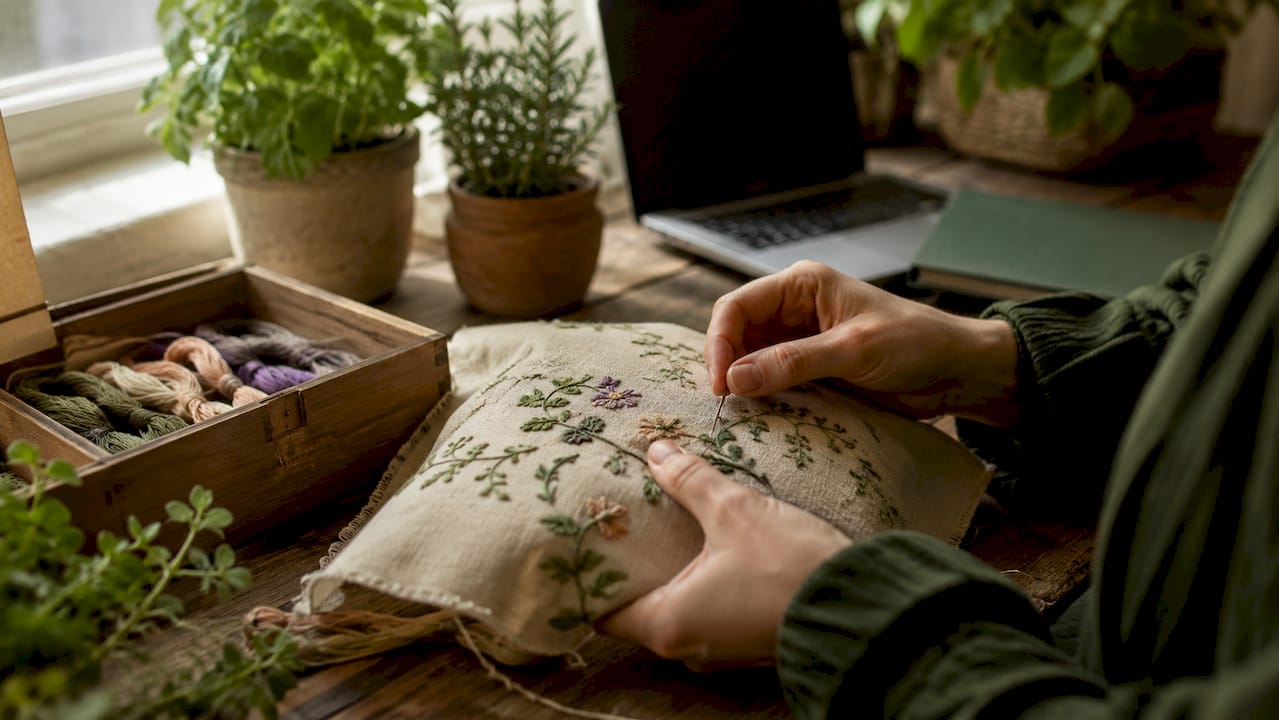
Specific stitches replicate the textures and structures found in nature far better than others. Matching the right stitch to the right element is what separates a flat design from one that feels alive.
Core stitches and what they do best:
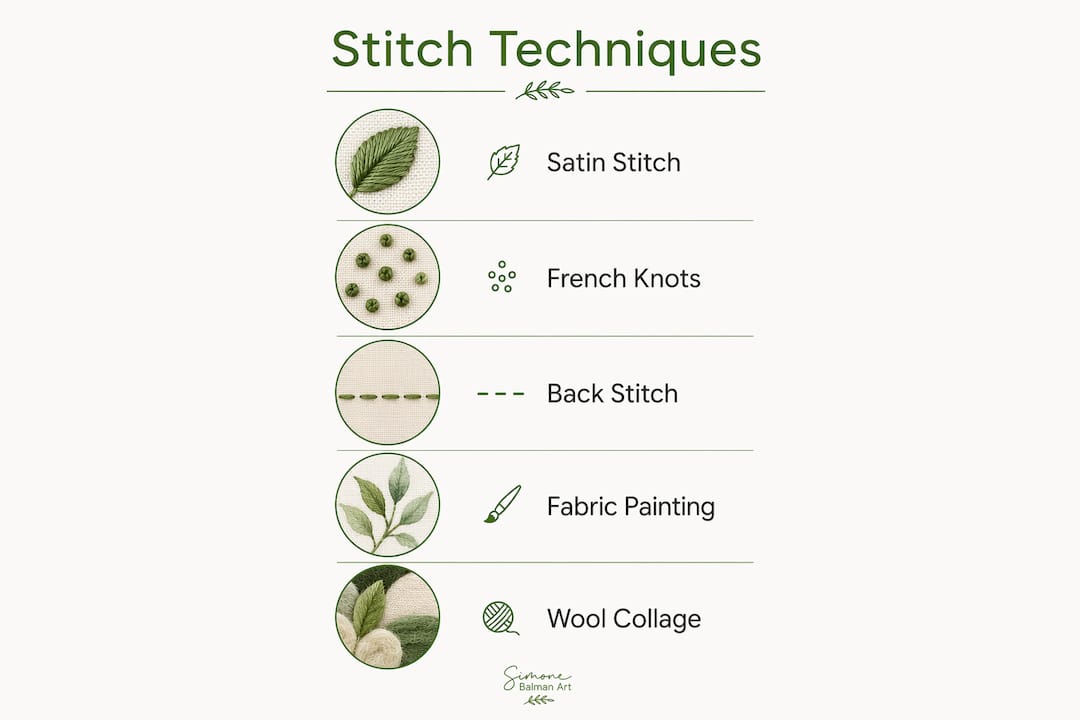
- Satin stitch: Fills petals and leaves with smooth, solid color. Works beautifully for tulip petals or magnolia blooms where you want a clean, polished surface.
- French knots: Creates seeds, flower centers, berry clusters, and the rough texture of bark. A cluster of French knots in a sunflower center looks remarkably realistic.
- Chain stitch: Builds thick, textured outlines and works well for stems, branches, and the raised ridges of a leaf.
- Back stitch: Draws fine lines like leaf veins, grass blades, and feather details. It is the most precise outlining stitch available.
- Lazy daisy stitch: Forms individual petals and small leaves quickly. Perfect for wildflower meadow designs where you need many small shapes fast.
Combining traditional stitching with experimental methods like fabric painting and collaging with raw wool helps capture depth and texture that thread alone cannot always achieve. A stitched rock face, for example, gains real dimension when you layer painted fabric underneath your stitching. Raw wool couched onto fabric creates a convincing mossy texture.
Pro Tip: Layer your stitches. Use satin stitch as your base fill, then add French knots on top for dimension. This two-layer approach gives petals and leaves a sculptural quality that single-stitch fills cannot match.
How do stitch designers balance realism and stylization?
The biggest misconception in nature themed embroidery is that you need to replicate nature exactly. You do not. Stylization and abstraction are preferred over exact replication for effective nature inspired stitch patterns. This approach yields repeatable motifs that work well on fabric and feel natural despite lacking strict realism.
Stylization means you exaggerate the curves of a petal, simplify a leaf into three clean shapes, or repeat a bark texture as a geometric grid. The result is a motif that is easier to stitch, easier to repeat, and often more visually satisfying than a photorealistic attempt.
| Approach | Characteristics | Best for |
|---|---|---|
| Realistic | Fine detail, many thread colors, complex shading | Statement pieces, advanced stitchers |
| Stylized | Simplified shapes, limited palette, repeatable | Patterns, beginner projects, borders |
| Abstract | Geometric interpretation, bold color, graphic feel | Modern decor, mixed media projects |
The role of symmetry in stitch design is worth understanding carefully. Mixing fills that require different symmetry types in repeating patterns causes grid alignment problems. That said, slight detail variations within a symmetrical structure add an organic, natural feel rather than a rigid, mechanical one. Think of how leaves on a real branch are never perfectly identical. Your stitched leaves do not need to be either.
Pro Tip: When designing a repeating border or fill, sketch your motif on graph paper first. Rotate and mirror it to test symmetry before you commit to stitching. This saves hours of unpicking.
Modern designers now treat botanical motifs as engineered systems rather than decorative elements. They apply plant adaptation logic, like how a fern unfurls or how bark protects a tree, to create stitch designs with structural integrity. This thinking produces patterns that feel purposeful rather than merely pretty.
What are practical steps to start a nature inspired stitching project?
Starting a nature inspired project is more rewarding when you follow a clear process. Rushing straight to the hoop often leads to designs that feel disconnected or unfinished.
Observe and document. Spend time outdoors with a sketchbook or camera. Notice the specific curve of a particular leaf, the color variation in a single flower petal, or the way light hits a bird’s wing. Stitching a nature journal over weeks or months before completing final pieces captures authentic textures and growth stages that memory alone misses.
Choose your primary motif. Pick one central element: a single botanical specimen, a bird species, or a landscape view. Trying to include everything at once produces cluttered designs. Start focused and add supporting elements later.
Plan your composition. A collage-style layout works well for nature themed embroidery. Cut paper shapes representing your motifs and arrange them on a blank sheet before drawing anything. This lets you test balance and spacing without committing to a single arrangement.
Select your fabric and thread count. Your fabric count determines how fine your detail can be. A 28-count evenweave supports fine botanical detail. A 14-count Aida works well for bolder, simpler designs. Use a fabric size calculator to confirm your fabric dimensions before cutting.
Choose your stitch palette. Match stitches to textures as described above. Write a simple stitch plan: petal = satin stitch, center = French knots, stem = chain stitch. This keeps you consistent across the whole piece.
Stitch in layers. Work background elements first, then midground, then foreground details. This mimics how nature actually looks, with depth and overlap creating a sense of space.
Add mixed media if you want depth. Watercolor washes on fabric before stitching create a soft, painterly background. Couched raw wool or fabric scraps add tactile texture. These techniques are optional but they lift a design from flat to dimensional.
Seasonal projects work especially well for beginners. Stitch a spring wildflower sampler in march and april. Move to a summer botanical in june and july. Each season gives you fresh observation material and a natural deadline that keeps momentum going.
A Chinese landscape cross stitch pattern is a great example of how landscape elements translate into structured, stitchable compositions. Studying finished patterns before designing your own teaches you how experienced designers solve the challenges of depth, color, and motif placement.
Key Takeaways
A nature inspired stitch design succeeds when you combine the right motifs, a cohesive natural color palette, and stitches matched to the textures you want to recreate.
| Point | Details |
|---|---|
| Motif drives mood | Choose flora, fauna, or landscape motifs based on the feeling you want your finished piece to create. |
| Stylize, don’t replicate | Simplified and abstracted motifs stitch more easily and look more balanced than photorealistic attempts. |
| Match stitch to texture | Use satin stitch for smooth fills, French knots for seeds and centers, and back stitch for fine line detail. |
| Symmetry needs planning | Mixing symmetry types in repeating fills causes alignment problems; plan on graph paper before stitching. |
| Start with observation | Spending time documenting nature before you stitch produces more authentic and original designs. |
Why nature designs are the most forgiving place to start
I have designed cross stitch patterns across many themes, and nature motifs consistently give stitchers the most creative freedom with the least frustration. Here is why: nature is never perfectly symmetrical, and neither is your stitching. A slightly uneven petal reads as organic, not as a mistake. That built-in forgiveness makes nature inspired work genuinely enjoyable for beginners and experienced stitchers alike.
What surprises most people is how much structural intelligence natural forms carry. Curving stems and overlapping leaves create reliable compositional guides that feel balanced and stable without requiring formal design training. Nature has already solved the composition problem for you. Your job is to observe carefully and translate faithfully, not to invent from scratch.
The creative challenge I find most interesting is the tension between freehand expression and repeatable pattern design. A freehand stitched flower can be breathtaking. But if you want to stitch it again, or share it as a pattern, you need to stylize it. That process of moving from observation to abstraction to repeatable chart is where the real design skill lives. It takes practice, but it is deeply satisfying when it clicks.
My honest advice: keep a small sketchbook with you for a month and draw one natural thing each day. A seed head, a bark texture, a cloud formation. By the end of the month, you will have more stitch design ideas than you can use in a year.
— Simone
Nature inspired patterns and tools at Simone Balman Art
Simone Balman Art offers a collection of nature themed cross stitch patterns designed to make your next project feel approachable and beautiful from the first stitch.
The Mediterranean Courtyard pattern brings rich botanical and architectural motifs together in one design, showing how plant life and structure can coexist in a single composition. For stitchers who love impressionist florals, the Monet inspired pattern captures the soft, layered quality of garden flowers in cross stitch form. Before you start any project, the free pattern size calculator at Simone Balman Art helps you scale your design to your fabric perfectly. Browse the full pattern shop to find your next nature inspired project.
FAQ
What is a nature inspired stitch design?
A nature inspired stitch design is textile art that uses natural motifs like flowers, leaves, birds, and landscapes as its subject, translated into thread using techniques like satin stitch, French knots, and back stitch.
What stitches work best for botanical embroidery?
Satin stitch fills petals and leaves smoothly, French knots create seeds and flower centers, and back stitch draws fine details like leaf veins and grass blades.
Do I need to be realistic in nature themed embroidery?
No. Stylization and abstraction produce more repeatable and visually balanced results than photorealistic embroidery, and they give you far more creative freedom.
What is the role of symmetry in stitch design?
Symmetry guides how repeating motifs align on fabric. Mixing symmetry types in a single fill pattern causes grid alignment problems, so plan your symmetry approach before you begin stitching.
How do I start a nature inspired stitching project as a beginner?
Start by observing and sketching one natural element, choose a simple motif, plan your composition on paper, and use a fabric calculator to confirm your fabric size before cutting.


