

When converting threads between brands, prioritize value (lightness or darkness) over exact hue every time. That single rule saves more projects than any chart ever will. Here are three things to do before you buy a single skein:
- Check a conversion chart for your original color number (DMC, Anchor, Madeira, or Cosmo).
- Compare value, not just color. Hold both threads at arm’s length. If the lightness matches, the hue difference usually disappears at viewing distance.
- Stitch a 10×10 swatch on scrap fabric of the same count before committing to a full project.
When no single substitute matches closely enough, blend one strand of two different colors in your needle. This trick approximates missing shades with surprising accuracy and costs you nothing but a few minutes of testing.
Pro Tip: Blending works best when both strands share the same value. Mix a slightly warm and a slightly cool version of the target hue for a natural, balanced result.
Table of Contents
- How to use cross stitch thread conversion charts effectively
- What color-matching principles give you the most accurate results
- How to substitute thread types and adjust strand counts
- A step-by-step workflow for safe thread conversion
- What tools and resources help most with thread conversion
- How to test your substitutions for the highest confidence
- Key Takeaways
- The mistake that trips up even experienced stitchers
- Simone Balman Art tools that make conversion easier
- Useful sources
- FAQ
How to use cross stitch thread conversion charts effectively
Conversion charts are roadmaps, not guarantees. Dye base and fiber differences mean that even a listed “equivalent” can look noticeably different once stitched, so treat every chart suggestion as a starting point that still needs visual verification.
Most charts assign a match-quality label to each pairing. Here is what those labels mean in practice:
- Exact: Very close in hue, value, and saturation. Safe for backgrounds and large fills.
- Close: Minor shift in tone or sheen. Fine for accent areas; swatch before using in large fills.
- Approximate: Visible difference. Use only when the original is unavailable, and always swatch first.
The table below shows the kind of information worth recording when you build your own conversion notes for a project:
| Original brand & number | Suggested equivalent | Match quality | Strand count / coverage note | Caveats |
|---|---|---|---|---|
| — | — | Close | 2 strands on 14-count Aida | Anchor slightly cooler; check in natural light |
| — | — | Exact | 2 strands on 28-count evenweave | Consistent dye lot; buy enough in one purchase |
| — | — | Approximate | Test on scrap first | Cosmo slightly more orange; not ideal for large fills |
| — | — | Close | 2 strands standard | Sheen slightly higher in Madeira |
Pro Tip: Keep a small project notebook or a digital note with one row per color. Record the original number, the substitute, match quality, and the dye lot number. You will thank yourself the moment you need to reorder mid-project.
Some shades are simply worth keeping in the original brand. Highly saturated reds, skin tones, and specialty colors (like DMC’s hand-dyed or Color Variations range) rarely have a true equivalent across brands. Flag those colors before you start and budget to buy them as specified.
What color-matching principles give you the most accurate results
Value is the single most important factor in a successful thread substitution. At a normal viewing distance, the human eye reads lightness and darkness before it registers hue. A substitute that matches value but shifts slightly in temperature will look harmonious in a finished piece; one that matches hue but is a full step lighter will pop out of the design like a spotlight.
Undertone and sheen matter too, especially in large fills. Warm-toned threads (yellow or red undertones) read differently from cool-toned ones (blue or green undertones) even when the value is identical. Fiber treatment also plays a role: mercerized cotton has a brighter sheen than unmercerized, and that difference shows up clearly in side-by-side swatches.
For the most accurate digital matching, look for tools that use the CIEDE2000 algorithm. CIEDE2000 weights color differences the way the human eye actually perceives them, making it far more reliable than simple RGB or HEX distance calculations, particularly for skin tones and subtle shades.
Here is a quick testing checklist to run before you commit to any substitution:
- Compare threads in natural daylight, not under incandescent or fluorescent bulbs.
- Place both threads on the same fabric you will stitch on (Aida, linen, and evenweave reflect light differently).
- Record your observations in writing: value match, undertone shift, sheen difference.
- Step back two feet and reassess. Minor differences often resolve at viewing distance.
Lighting conditions after stitching also affect how colors read. A piece framed behind glass will look different under warm gallery lighting than it did on your lap in afternoon sun. If the finished piece will live in a specific room, test your threads under that room’s light source.
How to substitute thread types and adjust strand counts
Stranded cotton floss (like DMC, Anchor, Madeira, and Cosmo) is divisible into individual strands, which gives you precise control over coverage and texture. Pearl cotton (perlé) is non-divisible, so you cannot thin it down by splitting strands. That single difference changes everything about how you plan a substitution.
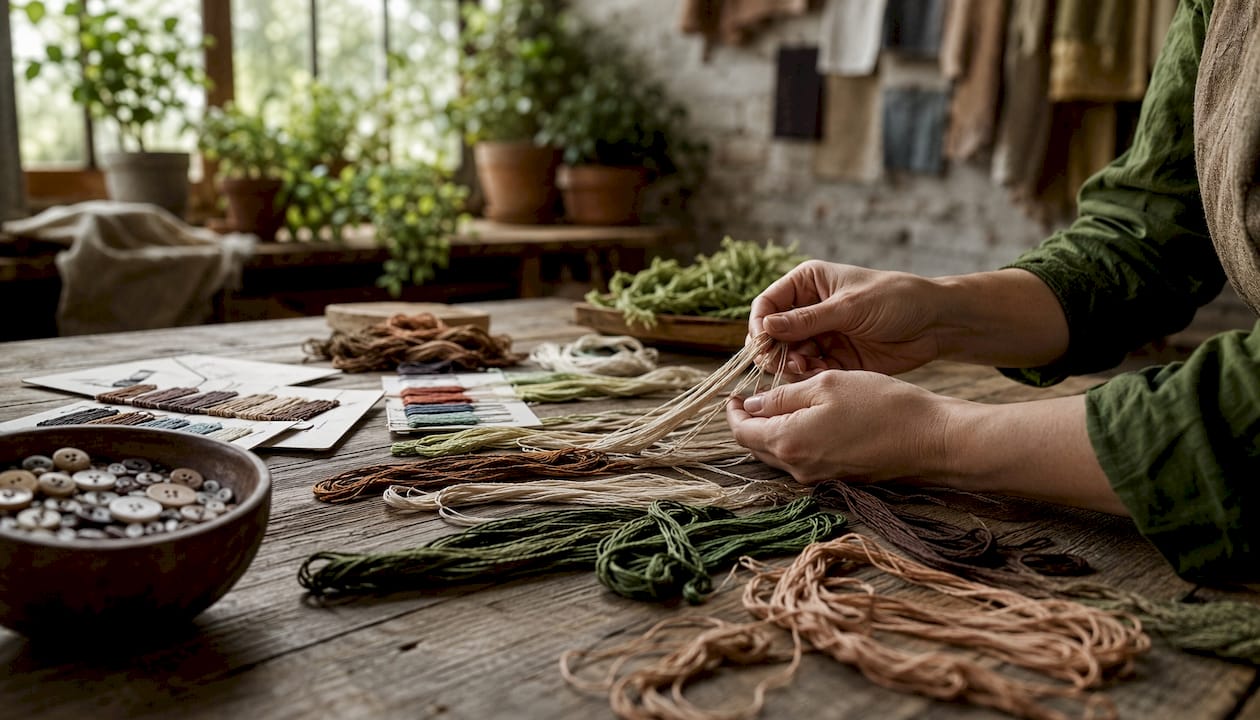
When switching from stranded floss to pearl cotton, choose the pearl size based on your fabric count and desired coverage. A size 8 pearl works well on 14-count Aida; a size 12 suits higher counts. Because you cannot reduce thickness by splitting, test a coverage swatch on scrap fabric before starting. The sheen will also be noticeably higher with pearl cotton, which can be a beautiful effect or a jarring one depending on the design.
Metallic threads bring their own challenges. They add sparkle but tend to fray and break more easily than cotton. Use shorter lengths (no more than 12 inches at a time), a larger needle to reduce friction, and expect to stitch more slowly.
For strand count adjustments between stranded brands, Anchor is often slightly thicker per strand than DMC. On 14-count Aida with a 2-strand DMC pattern, you may find that 2 strands of Anchor gives slightly denser coverage. Try 1 strand on a swatch first to see if the coverage still reads correctly. For variegated floss, substitution is trickier because the color sequence changes with strand length; if you cannot find a matching variegated, a solid color in the dominant hue is usually the safest swap.
Pro Tip: When stitching “over 1” on high-count linen (28-count and above), use a single strand and test coverage carefully. A slightly thicker substitute strand can make fine detail areas look muddy.
A step-by-step workflow for safe thread conversion
Follow this workflow before and during any project where you are substituting brands or colors:
- List every color in the pattern with its brand and number.
- Run each number through a conversion chart (DMC ↔ Anchor, DMC ↔ Madeira, or DMC ↔ Cosmo).
- Flag problem colors: highly saturated shades, skin tones, and specialty threads that have only “Approximate” matches.
- Buy or blend: purchase the suggested substitute for Close/Exact matches; plan a blending solution for Approximate ones.
- Stitch a swatch: 10×10 blocks on the same fabric, same strand count, same needle size.
- Compare in natural light: check value, undertone, and sheen against the original.
- Label your threads: attach a small paper tag or use a floss organizer card with the original number, substitute number, match quality, and dye lot.
For mixing brands within a single project, keep each continuous color block in one brand. Even chart-listed equivalents can show subtle differences when stitched side by side. Mix brands only at design boundaries (where two different colors meet), never within a fill area.
Here is a compact labeling template you can copy into your project notes:
| Original | Substitute | Match quality | Dye lot | Notes |
|---|---|---|---|---|
| — | — | Close | — | Cooler tone; verified in daylight |
| — | — | Exact | — | Consistent; bought 3 skeins same lot |
| — | Keep original | N/A | — | No close substitute found |
What tools and resources help most with thread conversion
The most reliable starting point for any conversion is a brand-specific conversion chart. DMC, Anchor, Madeira, and Cosmo all publish official charts, and several online tools compile them into searchable databases. Here is a quick breakdown of the tool types worth knowing:
- Printable conversion charts: Good for offline reference. Download and keep one in your project bag.
- Online converters: Fast for bulk lookups. Look for tools that show match-quality ratings alongside suggested equivalents, not just a number.
- Perceptual-matching tools: The most accurate option for subtle shades. Prefer tools that cite CIEDE2000 as their matching algorithm.
- Manufacturer color cards: Physical cards with real thread samples. These are the gold standard for final verification because screen color accuracy is limited; a physical sample accounts for sheen, twist, and how light interacts with the fiber in a way no HEX value can.
Simone Balman Art offers a free thread conversion tool that generates initial brand equivalencies quickly, and a DMC closest matches reference for fast lookups. Use these to build your initial substitute list, then verify with physical swatches. The floss calculator also helps you estimate how many skeins of a substitute you need, which matters when you are buying from a single dye lot.
Pro Tip: If you are working on a portrait or a design with subtle skin tones, invest in the manufacturer’s physical color card for your target brand. The difference between DMC 3774 and 3779 is nearly invisible on screen but obvious in hand.

How to test your substitutions for the highest confidence
A repeatable test plan removes guesswork and gives you real evidence before you commit to hundreds of stitches. Here is the method:
- Cut a 6-inch length of each candidate thread (original and substitute).
- Stitch a 10×10 block of each on scrap fabric matching your project’s count and color.
- Photograph the swatches in natural daylight, ideally near a north-facing window for consistent, shadow-free light.
- Compare side by side on the fabric, not in your hand. The fabric background changes perceived color significantly.
- Note value, undertone, and sheen in your project notebook.
- Check under a second light source (warm lamp or evening light) to see how the match holds across conditions.
Physical color cards beat HEX and RGB previews every time for final approval. Digital values cannot reproduce how light interacts with thread texture and sheen. For a computed match using CIEDE2000, a delta value below 2.0 is generally considered a perceptually close match; above 5.0, the difference will likely be visible in a finished piece.
Buy thread from the same dye lot for any color that covers a large area. Batch variation is a real and frequent conversion challenge. If you must buy from a second lot mid-project, flag the lot change in your project notes and test the new skein against the original before stitching.
Pro Tip: Pre-sorting your threads side by side before you start stitching is one of the best ways to catch a bad match early. Pre-sorting floss takes ten minutes and can save hours of unpicking.
Key Takeaways
Successful cross stitch thread conversion comes down to three habits: prioritize value over hue, always swatch before committing, and keep critical shades in the original brand when no close match exists.
| Point | Details |
|---|---|
| Value before hue | Match lightness/darkness first; minor hue shifts disappear at normal viewing distance. |
| Swatch every substitution | Stitch a 10×10 block on the same fabric and count before starting the project. |
| Flag critical shades | Keep highly saturated reds, skin tones, and specialty colors in the original brand when no Exact or Close match exists. |
| Blend strands to approximate | Mix one strand each of two close colors when no single substitute matches the target shade. |
| Simone Balman Art tools | Use the free thread conversion tool and DMC closest matches reference for initial planning, then verify with physical swatches. |
The mistake that trips up even experienced stitchers
The most common error in thread conversion is not choosing the wrong substitute. It is mixing two brands inside the same fill area and only noticing after fifty stitches. Even a “Close” match can show a subtle value shift when stitched adjacent to the original, and that shift reads as a mistake rather than a design choice.
The fix is simple but easy to skip when you are excited to start: flag every color that has only an Approximate match before you cut a single thread. Either buy one skein of the original brand for those shades or plan a deliberate blending solution and test it on scrap fabric first. Record the substitution in your project notes with the dye lot number. If you run out mid-project and need to reorder, you will know exactly what you used.
The workflow in this article is not complicated, but it does require doing the steps in order. Swatch first, compare in natural light, label your threads, and mix brands only at boundaries. Follow that sequence and you will rarely need to unpick.
Simone Balman Art tools that make conversion easier
Converting threads for a new pattern takes time, but the right tools cut that planning time significantly. Simone Balman Art’s free thread conversion tool gives you instant brand equivalencies across DMC, Anchor, Madeira, and Cosmo, with match-quality guidance built in. Pair it with the embroidery floss calculator to estimate exactly how many skeins of each substitute you need, so you can buy from a single dye lot and avoid mid-project shortages.
These tools work beautifully alongside any Simone Balman Art pattern, including detailed designs like the dragon cross stitch pattern where precise color matching makes a real difference to the finished piece. Every pattern comes with a clear color list, so you can run your conversion planning before you buy a single skein. The tools speed up the planning stage, but physical swatching remains the final word on any substitution. Start your next project with a conversion plan you can trust.
Useful sources
The following resources informed this article and are worth bookmarking for your own conversion research:
- DMC Thread Substitution Guide for Cross Stitch — Practical guidance on value-first substitution and strand blending.
- DMC vs Anchor Thread Conversion: Complete Guide & Chart — Detailed brand comparison with dye lot and fiber-difference notes.
- DMC Color Chart with Anchor Equivalents — Full color reference with CIEDE2000-based matching notes.
- How to Substitute DMC, Anchor & Madeira Thread Brands — Covers mixing rules, physical verification, and match-quality ratings.
- Beyond Floss: Cross Stitch with Pearl Cotton & Alternative Threads — Explains coverage and sheen differences when switching thread types.
A reminder: manufacturer physical color cards are the most reliable final reference for any critical substitution. Test swatches under natural daylight, record your results, and enjoy the process.
FAQ
What is the most important rule for thread conversion?
Prioritize value (lightness or darkness) over exact hue. At normal viewing distance, minor hue differences are far less visible than a mismatch in lightness, so match value first and verify with a swatch.
Can you mix DMC and Anchor thread in the same project?
Yes, but keep each continuous color block in a single brand. Mix brands only at design boundaries, not within fills, because even chart-listed equivalents can show subtle differences when stitched side by side.
How do you convert DMC thread to Anchor or Madeira?
Use a conversion chart to find the suggested equivalent, note the match quality (Exact, Close, or Approximate), then stitch a 10×10 swatch on your project fabric and compare in natural daylight before committing. Simone Balman Art’s free thread conversion tool is a fast way to generate an initial list.
Why does a converted thread look different even when the chart says it matches?
Dye base, fiber treatment, and sheen all affect how a color reads once stitched. Two threads with identical HEX codes can look noticeably different on fabric because physical light interacts with thread texture in ways a digital value cannot capture.
When should you just buy the original thread color?
Buy the original when a conversion chart rates the substitute as Approximate, or when the color is a highly saturated red, a skin tone, or a specialty thread with no close equivalent. For large fills or critical design elements, the original is always the safer choice.


